23 July 2026
Open a Subsidiary vs. a Branch in Ireland
Our Irish law firm can provide you with information about the rules and regulations related to the process of opening a branch or a subsidiary in Ireland.

A foreign company interested in expanding its business in Ireland may opt for one of the two legal options, which are represented by the subsidiary and the branch office. Although they are similar structures, they have a set of differences – for example, in relation with the level of independence the branch office/subsidiary has with its parent company.
In the case of the Irish subsidiary, the structure represents a separate legal entity that is taxed in accordance with the company legislation available in Ireland. The branch office is also liable for taxation in Ireland, but for specific types of incomes; when referring to the level of independence towards the parent company, the branch office is seen as a sub-division of the company operating abroad. Please find below a detailed guide on opening a subsidiary vs. a branch in Ireland.
Our team of Irish lawyers is experienced in providing legal assistance related to the incorporation of the two business forms in 2026. At the same time, our lawyers can offer advice on the main advantages provided by the two legal entities in accordance with the budget and the business plans the investors have. We also provide assistance to those interested in other matters, such as divorce in Ireland.
| Quick Facts | |
|---|---|
| Applicable legislation (home country/foreign country) | Irish law for the subsidiary, foreign country law (subject to requirements) for the branch. |
| Best Used For | Branch: to expand a foreign company’s activities in Ireland. Subsidiary: to open a local company owned by a foreign entity. |
| Minimum share capital | No minimum share capital for a private company limited by shares (at least one share must be issued). |
| Time frame for the incorporation (approx.) | Five business days for the subsidiary, more for the branch. |
| Documents to be filed by parent company | For the branch: articles of association, proof of appointing a local representative. |
| Management (Local/Foreign) | Local for the subsidiary, foreign for the branch |
| Legal representative required | Yes |
| Local bank account | Yes |
| Independence from the parent company | The subsidiary is independent whilst the branch is not. |
| Liability of the parent company | The foreign company is only partly liable for the subsidiary (to the extent of shares owned). It is fully liable for the branch. |
| Corporate tax rate | 12.5% corporate income tax on trading income (25% on non-trading income); 15% minimum effective rate for groups with annual revenue of at least EUR 750 million (Pillar Two) |
| Annual accounts filing requirements | Accounting as per the parent company rules for the branch (filed in Ireland as needed). Accounting requirements and filing as per the Irish laws for the subsidiary. |
| Possibility of hiring local staff | Possible in all cases |
| Travel requirements for incorporating branch/subsidiary | Not mandatory |
| Double tax treaty access | As per the double tax treaties signed by Ireland. |
Opening a subsidiary in Ireland in 2026
Before investing in Ireland, a businessman should know that a subsidiary is an independent legal entity, different from the one set up in the country of origin. Investors are usually interested in this type of legal representation as the liability of the parent company is limited to the share capital invested in the subsidiary.
The minimum requirements imposed by the Irish law system related to the establishment of a subsidiary are presented below and our team of lawyers in Ireland can provide in-depth legal assistance on the conditions for registering a local subsidiary of a foreign company:
- the subsidiary is generally registered as an alimited company, more specifically, a private company limited by shares;
- it is necessary to appoint at least one director (plus a separate company secretary if there is only one director), and at least one director must be resident in the EEA unless a EUR 25,000 bond is held or a real and continuous link certificate is obtained;
- provide the company constitution (for an LTD a single-document constitution, without a memorandum), as well as the resolution of the parent company which presents the decision of opening a subsidiary;
- have a registered office, with an official business address in Ireland.
The subsidiary must register with the Revenue Commissioners for paying the corporate tax, Value Added Tax, Pay Related Social Insurance for the company’s employees and Relevant Contract Tax. Our attorneys in Ireland can offer you the legal support for opening a subsidiary here and register the company’s employees for taxation.
The infographic below presents the main characteristics of a subsidiary and a branch office in Ireland:
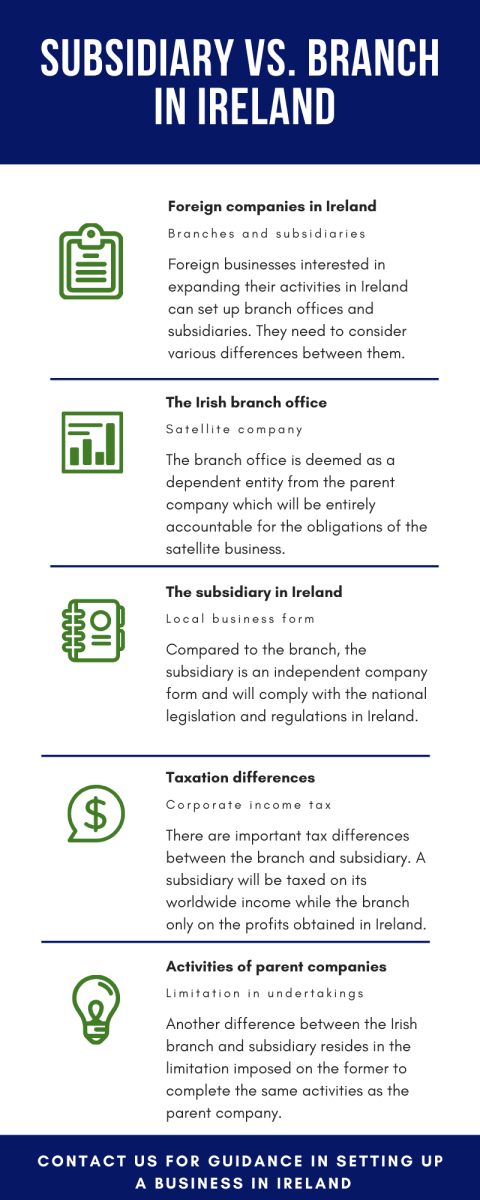
When opening a subsidiary in Ireland, the investors can choose from one of the business entities available under the Irish commercial legislation. However, most of the companies registered in Ireland take the form of a limited liability company, which, overall, provides the most advantageous conditions for the majority of the businessmen. It is important to know that during the incorporation procedure, the investors should also draw the company’s statutory documents – the articles of association and memorandum, as mentioned earlier.
No notarisation is required in Ireland; the incorporation documents (Form A1 and the constitution) are filed with the CRO, usually online, who will attest that the documents are completed following the applicable legislation. Like any other company in Ireland, the subsidiary will need to be registered with the Companies Registration Office, which is the main institution regulating the activity of commercial businesses in this country.
What are the main accounting requirements imposed on Irish subsidiaries?
A subsidiary in Ireland is required to comply with a set of accounting procedures, which can be detailed by our team of Irish lawyers. The company has to file its tax accounts and tax declarations with the Irish Tax and Customs Revenue Online Service, by using the institution’s online platform. The tax accounts have to be filed on an annual basis, while the value added tax (VAT) returns have to be submitted every two months.
The payment of capital gains tax for Irish subsidiaries
The gains obtained from the disposal of capital assets are generally taxed in Ireland at a rate of 31% (for disposals on or after 7 October 2026; previously 33%, and still 33% for development land) or 40%, which is also applicable to companies established as subsidiaries. In the case of a holding company that concludes disposal of shares to one of its subsidiaries an exemption from taxation is granted, but this is applicable only in certain conditions.
For example, the tax exemption is granted provided that the subsidiary is established in Ireland, in a country that is a member state of the EU or if the company benefits from the provisions of a double taxation treaty. At the same time, the exemption is available for a subsidiary that is a part of a group or registered as a trading company.
It is also important to know that the capital gains tax is not applicable in the situation in which the parent company owned at least 5% of the subsidiary’s shares for a period of minimum 12 months on a continuous basis. Our team of lawyers in Ireland can provide further information concerning other tax exemptions that can be applied to Irish subsidiaries.
Opening a branch office in Ireland in 2026
A branch office depends on the parent company and cannot make its own business decisions. Still, the Irish government offers incentives for foreign companies interested in opening a branch office in Ireland, by giving, for example, various tax exemptions. Our Irish lawyers can present to you more details about the benefits of opening a branch office in Ireland.
In order to set up a branch office, an investor should submit a wide range of documents and it is important to know that in this case, the Irish authorities will request a larger number of official documents than in the case of a subsidiary:
- a notarized stamped copy of the foreign company’s memorandum and articles of association;
- a copy of the certificate of incorporation of the parent company;
- the list of directors of the parent company and a copy of the annual accounts;
- the name of the Irish resident person who is authorized to act on behalf of the company;
- a registered address of the Irish branch office and any changes that can occur related to the property owned by the company, its share capital or the company’s trading name.
Furthermore, a branch in Ireland is also required to report any changes regarding the company’s statutory documents and any changes related to the person who is authorized to represent the branch. In the situation in which the company is closed down, the company’s representatives are also required to notify the local authorities by submitting a note of insolvency or liquidation, depending on the situation of the company.
In case you need company formation services in a different country, for example in China or assistance in setting up an offshore company in Belize, we can put you in contact with our partners.
What are the main tax requirements for Irish branches?
In terms of taxation, companies established as branch offices in Ireland will be liable for paying the corporate tax only with respect to their activity conducted on the Irish territory. Also, the branch will need to register for taxation purposes, including those related to the taxation of the employees working in the respective establishment. As a general rule, the branch office in Ireland has to be registered following the provisions of Part 21 of the Companies Act 2014 (which replaced the 1993 Branch Disclosure Regulations).
When operating in Ireland through a branch office, the company’s representatives are also required to file specific tax and accounting documents with the tax authorities. In this sense, the company must provide its annual accounts,annual reports of the directors, a report concluded by local auditors on the company’s accounts and another one regarding the director’s reports.
In 2026, the corporate income tax for the locally registered company and the branch tax rate are the same, set at 12.5% for trading companies and at 25% for nontrading entities. For the purpose of taxation, a resident company is considered as such if it is managed and controlled in the country (in some cases, it is considered a resident company if it is incorporated in Ireland – if the incorporation took place after 1 January 2015). A resident company will be subject to taxation on its worldwide profits, while a non-resident company will be subject to taxation on its Irish-source income (as well as capital gains tax on certain types of assets, such as land or building located in the country).
Understanding the differences between the branch and the subsidiary is also important in terms of annual reporting, accounting and bookkeeping. When working with our team of Irish accountants, you can make sure that the branch or the subsidiary of a foreign company operating in Ireland remains fully compliant. Reach out to us today for details about our services and a personalized offer.
Register a branch office with the Irish CRO
The registration of a branch in Ireland, just like in the case of any other business form available for incorporation in this country, is started at the Companies Registration Office (CRO), following the regulations of the Companies Act 2014. It is necessary to register with the CRO within 30 days of establishing the branch, i.e. of starting business activities in this country.
The registration with the Irish institution is completed in accordance with the country of origin of the parent company. Thus, companies registered in one of the member states of the European Economic Area (EEA) will have to complete the Form F12, while companies outside EEA will have to submit the Form F13. A detailed presentation on the meaning of EEA/non-EEA companies is given by the recently signed order – the Companies (Accounting) Act 2017 (Commencement) Order 2018.
Investors should know that certain categories of businesses are not allowed to register in Ireland under a branch office. This is the case of UK-based companies operating as limited liability partnerships, which are not entitled to perform business activities in Ireland through this business form.
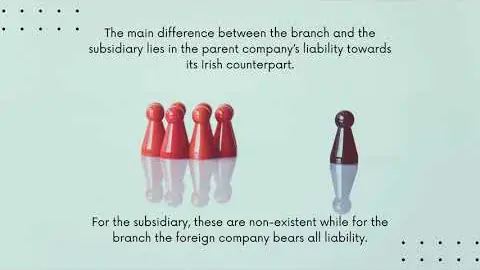
The video below presents how to open a subsidiary or a branch in Ireland:
Can one register a subsidiary Societas Europaea in Ireland?
Yes, a subsidiary can also take the form of a Societas Europaea (SE) in Ireland. The SE represents a type of entity that can be registered at the level of the EU, following the legislation stipulated by the European Commission. The main rules of law regulating this entity are given by the EU Regulation (Council Regulation 2157/2001).
The registration of a subsidiary SE is done through the CRO, where the investors have to complete the Form SE5. The applicants have to provide a set of details concerning the future company, such as its trading name, the location of the registered office, information on the company’s secretary, the company’s official e-mail address, information on the company’s directors and others.
Our team of Irish lawyers can advise on the formalities for registering a subsidiary SE in this country and can assist with information on the share capital of this structure, the requirements regarding the types of activities it can develop in Ireland and on any other inquiries regarding the legislation that regulates the SE.
What are some foreign investment statistics for Ireland?
As the branch office and the subsidiary are types of entities that can be used by foreign companies expanding into a new market (they can also be used by local businesses), we have prepared a presentation on the most important aspects that give a clear image on the foreign investment activities developed in Ireland. Our Irish law firm can assist investors with more details, including on the legislation regulating this sector.
The list below includes some recently released data on foreign direct investments in the country:
- Direct investment income outflows increased by €18.8billion during the second quarter of 2026, compared to the previous quarter;
- Direct investment income outflows amounted to €66.1billion in the second quarter of 2026;
- Two business sectors stand out as the ones with the most direct investment income outflow for the analysed period: manufacturing and information and communications;
- Manufacturing leads the charts for direct investment income outflow throughout the year, being the recipient of €44.4billion in the second quarter of 2026;
- All in all, direct investment into Ireland decreased by €17.5billion in Q2 2026.
A characteristic of the Irish economy is that the foreign companies operating here have better results compared to local companies, when referring to the industrial sector. For example, the value of foreign companies operating in this industry accounted for EUR 150 billion, compared to only EUR 32 billion reached by the local businesses.
Investors who are considering opening a branch office or a subsidiary in Ireland should also be aware of the fact that this country is the home of 24 of the 25 largest pharmaceutical companies that have set up their activities at an international level. Our team of Irish lawyers can advise on the regulations and the business permits that have to be obtained when operating in the pharmaceutical industry through a branch office or a subsidiary.
Our law firm in Ireland can also offer you legal representation in the company registration proces,s as well as services related to Family Law, such as assistance for divorce in Ireland.
If you are interested in expanding your business in Ireland in 2026, please contact our lawyers in Ireland, who can help you choose the best business form for your needs: either a branch or a subsidiary.