2 April 2026
Real Estate Investment Trusts in Ireland
Learn how real estate investment trusts (REITs) work in Ireland as listed companies earning income from property, and how our lawyers assist with setup.

Real estate investment trusts (REITs) in Ireland are listed companies used for deriving income from residential or commercial property.This type of investment fund is a legally recognised entity available across the world and foreign investors who are interested in opening a company in Ireland in this field will have to list the company on the main market of a recognised EU stock exchange (such as Euronext Dublin, formerly the Irish Stock Exchange). A REIT in Ireland offers several benefits for investors, and along with those related to the income derived from this investment made in properties, the trust also offers access to a lower-risk investment model.
| Quick Facts | |
|---|---|
| Assitance for creating a real estate investment trust in Ireland | Our lawyers in Ireland provide complete assistance to those interested in setting up a real estate investment trust |
| Type of entity used to set up a real estate investment trust (REIT) | The corporation is commonly used. A close company is not to be used |
| Conditions for listing the company | A REIT must be a company that has its shares listed on a recognised stock exchange. |
| Special notification for the creation of a REIT | If an existing company intends to become a REIT, a notification is sent to the Irish Tax and Customs |
| Capital requirements for the REIT | EUR 25,000 for the public limited company |
| Number of founders | At least 1 (the Companies Act 2014 allows single-member companies, including PLCs) |
| Conditions for share ownership | Must be diversified |
| Can be formed as a company or group of companies (Yes/No) | Yes |
| Corporate tax | Exempt from corporation tax |
| Capital gains tax | Not applicable |
| Conditions for irish REIT taxation regime | To qualify for the tax exemption in Ireland, the REIT must be an Irish resident company |
| Stamp duty | Share transfers within the REIT subject to a 1% stamp duty tax. |
| Conditions for the REIT activities | Derive at least 75% of its prodits from a property rental business |
| Conditions for the rental property business | Consist of at least three properties, none being more than 40% of the total |
| Conditions for dividend distributions | Distribute at least 85% of its income in the form of dividends to its shareholders |
Our team of Irish lawyers briefly describes the characteristics of REITS in Ireland in this article and, upon request, can assist with the creation of a trust, as well as with essential legal counsel on issues of interest to investors.
The registration of a REIT in Ireland
When forming a new company established as a REIT in Ireland, the investors will have to present a set of documents at the Revenue Commissioners. The main requirements the investors should meet are the following:
- the company must be registered as an Irish resident legal entity;
- it was incorporated following the procedures available under the Companies Act;
- it is listed on the main market of a recognised stock exchange in an EU member state;
- it is not a close company (which refers to the number of investors).
If you are interested in the registration of an Irish residential REIT, our team can give you more details.
While the existing laws discuss the registration of newly formed companies as REITS in Ireland, it is also possible to convert an existing company into a real estate investment trust. However, special considerations are taken in this scenario that have to do with the company’s tax liability. If converted, the REIT will not be used to eliminate inherent capital gains by taking advantage of the special tax regime. The experts at our law firm in Ireland can give you more details.
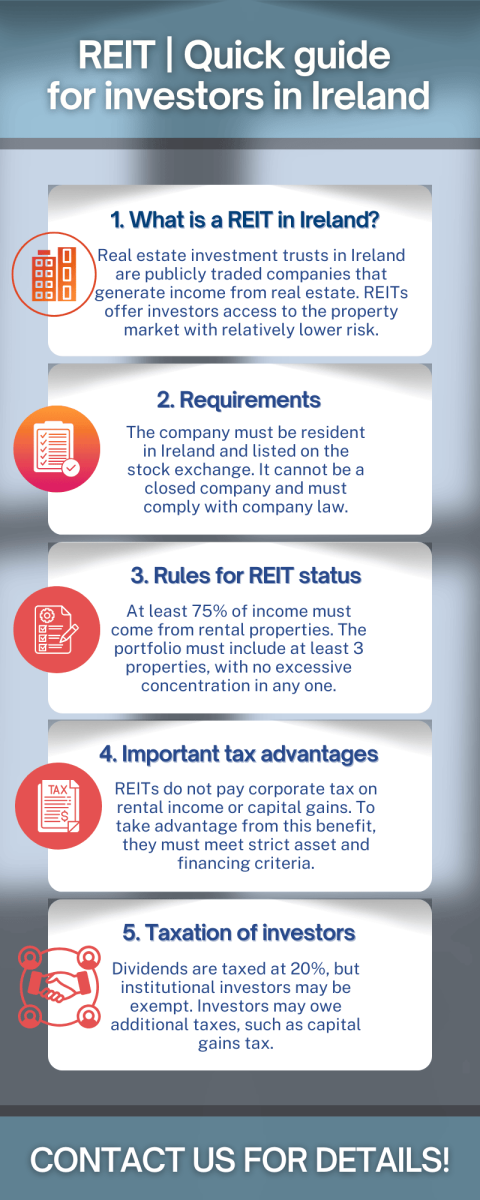
You can discover in the infographic below how REITs work in Ireland and what opportunities they offer to investors:
The taxation of an Irish REIT
The Irish tax laws provide for a special tax treatment for the REIT. For this to be possible, the real estate investment trust needs to meet several conditions and, if so, it will not be liable to corporate tax on income or capital gains that are derived from its property rental.
The following conditions apply to an Irish residential REIT, and to all forms of REIT, that wish to benefit from the special tax regime:
- it needs to be considered an Irish resident for tax purposes, it cannot be a tax resident elsewhere;
- is should derive at least 75% of the profits from a property rental business;
- it must hold at least 3 properties and none must be more than 40% of the total;
- the Irish REIT needs to have a 1.25 to 1 ratio of income to financing costs (maintained at all times);
- Irish REITS need to hold at least 75% of their asset, according to market value, in property rental business;
- it needs to keep a loan-to-value ratio of a maximum of 50%;
- REITS in Ireland are asked to distribute at least 85% of their income in the form of dividends to their shareholders.
Please note that the aforementioned conditions come in addition to the ones presented above by our attorneys in Ireland concerning the main requirements that need to be observed concerning the company that is set up as an Irish REIT.
Other tax considerations
As previously mentioned, companies that meet all the criteria imposed by the local authorities will be exempted from the corporation tax applicable to the rental profits or property gains. However, Ireland applies a withholding tax on dividends, imposed at the rate of 25%. The regulations in this sense specify an exemption from the payment of the withholding tax on dividends available for professional investors representing pension funds and several investment undertakings, on which our team of attorneys in Ireland can provide more details.
The distributions from an Irish REIT in the case of an Irish resident corporation are subject to 25% corporate tax. Additionally, Irish resident investors are subject to a 33% capital gains tax upon the disposal of shares. Our Irish lawyers can give you more details.
It is important to know that the Irish shareholders are also liable to taxation in a REIT. If the shareholders are tax residents in a foreign country, they can benefit from the stipulations of the double taxation treaties signed with that particular state regarding the taxation of dividends.
Our accountants in Ireland can answer your questions about the double tax treaty signed between your country of origin and Ireland, if this is applicable in your case.
Local and foreign investors can be interested in investments in Irish REITS, or the purchase of property in their own name, if preferable. Our Irish lawyers can answer a wide range of questions concerning the local property market.
In addition to our services related to property purchase and investments in specialised trusts, our team can also answer questions about divorce in Ireland.
Businessmen interested in receiving further details on the real estate investment trusts in Ireland can address to our Irish law firm.